Friday, December 24, 2010

Traps and Snares: Riddled Paths for Indian Wildlife

The following report was written for the Wildlife Trust of India during my short stint there. The report is up here on their website and was also published in the July issue of Planet Earth Magazine. 

The Law is a curious, self limiting conundrum. While it attempts to delineate and sustain order, it cannot function in a foolproof manner unless everything under its ambit is spelt out well.

Consider the Ministry of Environment and Forests (MoEF) putting out the Draft Wildlife (Protection) Amendment Bill 2010 in public domain and inviting comments from experts to further strengthen it. Enacted in 1972 and amended several times thereafter, one of the proposed amendments this year is to classify leg-hold traps as weapons. Also called jaw-traps or Khadka, these simple yet deadly devices with a vice like grip are a bane to large carnivores in our sanctuaries.

The insertion of Section 9A in the principal act bans sale, manufacture and use of the article as well as regulates its possession. With a DIY style of assembly, its metal components are slipped inside the sanctuary, perhaps masked as the base of a pot and then once inside, using their impeccable knowledge of animal habits, the poachers set up the trap. The ingenuity employed here is that sans the use of guns, a poacher merely has to go back to the area later and check whether an animal has been caught instead of lying himself in wait. Large traps are powerful enough to break the animal’s leg and designed without claws to prevent perforation of the carnivore’s skin. “If found alive, brutal methods – like driving a spear through the animal’s mouth – are deployed to kill it without damaging its skin,” says Ashok Kumar, Vice-Chairman, Wildlife Trust of India (WTI) and the first director of TRAFFIC-India.

The implication of the amendment is huge. For one, the user is liable to get prosecuted for even carrying dismantled parts of the trap in and around a protected area, let alone being found with the assembled trap.  Once proven that the parts belong to a weapon when assembled, it translates to an ‘intention to hunt’ under law.  However, an appeal now stands to broaden the definition of traps under Section 2, (17 A) to include ‘leg and neck hold traps’ to avoid more legal loopholes. “While the last amendment to the act only describes snaring and trapping, this year’s addition is an attempt to define the equipment,” says Prasenjeet Navgire, Programme Officer, WTI.

The debate here is that while limiting the definition to particular limbs, court cases may not hold ground if any other part of an animal gets caught, say its tail! Sudhir KS, Karnataka based Advocate and Managing Trustee of the lawyers’ collective, Voices for Wildlife opines, “The definition of the trap should be widened to include any apparatus which may cause damage, injury or death to any animal in any manner.”

With the leg trap now undergoing redefinition, here arrives an even simpler piece of metal under the scanner – the snare.  Nothing more than a piece of wire fashioned into a smooth noose in less than three minutes, it is used to poach deer, wild pigs, boars and hares. Ironically, the very solar fences lined up on park boundaries to prevent human-wildlife conflicts are now being used to poach animals. Used primarily for bush meat, snares along with traps are our wildlife’s silent killers.

The gravity of the situation is that once a snare is set up, one can’t predict what animal gets caught. Consider the fact that in Bandipur this year, two tigers were accidentally snared and killed. The same goes for traps.  Sudhir adds, “Under the current law, leg traps exclude the fact that rodents, hefty reptiles like pythons, or any animal may get caught. As for snares, what if an elephant’s trunk gets trapped? The wire gets embedded causing septicemia or even cuts through it, rendering the animal incapable of feeding itself.”

The intensity of killing by snaring remains unknown. Areas such as BR Hills and Nagarahole have villages located within them, which makes it even more difficult to establish how many kills have taken place.  Experiments with even metal detectors for both leg traps and snares proved impractical as they are best only for restricted spaces. Even so, there have been attempts made to use them on paths frequented by animals.

“With instances such as road kills, you can give a number, 91 or 100 etc but not with snares,” says Rajkumar, a Karnataka based conservationist. With vast tracts of wilderness, Rajkumar worries that it can get extremely difficult to patrol for this piece of wire, a veritable needle in a haystack.  They are a surefire way of getting your animal. The metal wire strangles the agitating animal and death occurs by stoppage of blood flow to the brain or suffocation. “Snaring peaks around the first and second bouts of showers before the actual monsoons,” adds Rajkumar. The watering holes are replenished after a long and parched summer, and animals become easy quarry.

Tactics such as narrowing down high pressure areas around PAs based on anthropocentric disturbances and knowledge of preference for meat among certain local tribes and communities helps concentrate on a 3–5 kilometre stretch of parks like Bandipur and Nagarahole. With the support of the local RFO and some volunteers, Rajkumar conducted an anti-snare combing programme. Twenty snares were retrieved over 40 days.

Rajkumar adds that up until last year, snares were recorded mostly for hunting bush meat. But of late, they are being used for poaching large carnivores.  The problem of snares is compounded when one understands the ecological aspects. With prey animals of larger carnivores being killed, the prey base is reduced and the animals are forced to venture into human settlements and end up attacking cattle or domestic livestock. This, in turn increases human-animal conflict.


It remains to be hoped that the amendments to the WPA only further strengthen one of the world’s best conservation acts in place. India’s vast biodiversity is caught in the incredible gamut of wildlife trade. And we can only wait and watch in the thirteenth hour, however riddled the paths its animals walk may already be.

Thursday, December 2, 2010

The Lost and Found Heart


She found it lying in the most unlikely place. Such a thing, when lost, is bound to be found in unlikely places. Forlorn, cobwebbed, a thick inch of dust covering it. But the shape was unmistakable. She picked it up, blew the grey dust off it, particles of which entered her nostrils, making her sneeze. A patch of pink appeared. She rubbed it with the tips of her fingers until almost all traces of dust and the stringy cobwebs were gone. Her right hand moved to the left of her chest, and gently undid a tiny clasp on two doors on her breast. They swung open creakily. She gently lifted the pink heart up and put it in the space, shut the doors and waited. As it fluttered again, struggling to break out and fly across oceans and continents, she knew she was ready to taste life once again.

Saturday, November 13, 2010

Bubbles

A friend in Delhi is going to be operated upon today for cancer.  

In Myanmar, Aung San Suu Kyi has been under house arrest for 15 years and is expected to be released in less than 48 hours.

Light at the other end of tunnel for two people in two different lands.

Thursday, October 28, 2010

DSLRs : Democratising Photography?


At a juncture where the machine does most of the work.


While quality photography has been delivered in the hands of everyone who can afford and own a high end DSLR, as well as opening up whole new perspectives and attitudes towards capturing moments, do DSLRs really “teach” photography to us, the average?

When someone pops the question, “What camera do you use?”, a tinge of irritation grips me. Because it is no more about the hands that hold the equipment or the eyes and mind that compose the frame, but the make and features of the camera. I struggle to answer, when friends go, “Teach me how you shot that?” or “I really ought to take lessons from you!” because at some base level, i am aware that i am letting the machine work its magic. And then again, when i was first gifted my Sony Cybershot digicam, i engaged with point and shoot. And continue to do so even now, with some degree of adjustments to the ISO, White Balance etc. But never exploring technical aspects to the fullest.

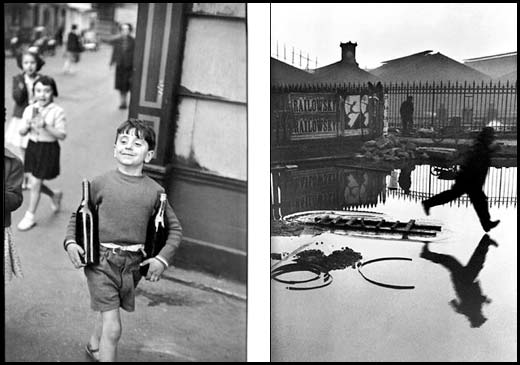
Though photo manipulation techniques have existed as long as form itself, the dark room techniques to bring out the best in a picture were based on far more complex knowledge and thinking than the simple act of tampering with contrast or colour on photo-editing softwares. Photozines too, these days, dedicate pages to explaining softwares than concentrating on the technique of understanding one’s subject, the nuances of photography etc . How long do you think Bresson spent on post processing these iconic photographs on Photoshop 8?


Or Bourke-White fiddling with the menu on her cam saying, “White Balance > Cloudy/Fluorescent/Incandescent/Night”?


Is photography today more about how pretty the picture or its subject looks than the story it tells?

Friday, August 20, 2010

Nostalgia Food

Our college visit to Madurai was under the auspices of that famous component by which the Asian College of Journalism thrives, the Covering Deprivation trip. Quite thought provoking at various levels, but also maddening because it boils down to sniffing out and snatching stories out of thin air where an unfamiliar language is spoken into. Apart from our perspective of deprivation loaded onto the villages ("oh dear lord, no mobiles! I wonder how they survive." Of course, the same village has television sets in every home along with a Sun Direct connection), there is also the matter of working on a "full stomach" while out covering stories in the hinterlands of India. 

While a certain group that went to Barmer last year, and another one that went to the Sunderbans the year before that, came back looking gaunt, dirty and hungry, the rest of us were well fed. Better, infact, than in the hostel. Now this brings us to this nightly reminscence of my first day in Madurai, and eating Idlis and vadai on a footpath in the shadow of the Meenakshi temple. With roughly half an hour to spare before being bundled into a tempo traveller for the day's schedule, two of us wandered down the alley from our hotel, very conveniently placed around the corner from one of temple's entries, in search of some little restaurant that the guys from our class had visited and declared "safe for the girls." The street was steadily growing busier, more people and more vehicles and cycle rickshaws were jostling for space.

And then in the distance, we spotted little tongues of steam issuing from a vessel slightly covered and placed on the footpath. An old lady sat next to it, frying vadai in a wok, spattering hot oil on a makeshift stove. A few patrons lined up and she served up two sticky idlis, one hot vadai on a banana leaf and then poured piping hot (it can't be anything else!) sambar genreously over the lot. I and V___ ordered for two plates and sat ourselves down on two cement bricks on the pavement next to the lady. At Rs 18/-, basking in mellow sunshine in the nippy January air, coupled with the sound of temple bells and chants ringing in the distance, it was the among the best breakfast we ever had.


Of course, now that we are on the matter of food in Madurai, one must not forget to mention, that it was here, that I tasted my first Dal Bhaati Churma in a certain Mohan's bhojanalay (i think), an authentic Rajasthani food outlet on the first floor near our hotel. Great stuff and I also learnt how to eat it the right way. "Usse poora thod kar, dal usme mila kar khaiye. Isiliye usse churma bolthe hain," aided the waiter when I tried breaking chunks of the pizza-like slice of the bread. We also had extremely awful Punjabi food in a Punjabi hotel with a Punjabi staff running it.  Lesson: North Indian food tastes good in north India. Same goes for south Indian food. 

But ah, here, the Jigarthanda must be paid an ode to. Originally from Madurai, but now popular all over Tamil Nadu and much relished by everyone, we proudly present to you:

A Tribute to Summer


As we swim our way on humid days through the yellow heat to Elliot’s Beach, all we want is a glass of Jigarthanda. As we round the corner near Murugan’s Idlis, we spot a crowd thronging a little stall outside the hotel. The men behind the counter are busy setting up cups, pouring in chilled pink liquid into them, scooping Khowa and ice-cream and handing them out to the melting customers. One large gulp and the concoction hits your stomach and a numbing feeling begins to spread through your teeth and lungs. And then, you play around with the jelly-like strands of China grass (also suspected as sea-algae or almond sap) in your mouth and gobble it down. And then the sweet after-taste of nannari, khowa and basundhi lingers. All charged up, you bound your way through the heat beating down your neck. Priced at Rs 15/- and Rs 20/- for the medium and large cups respectively, the Jigarthanda is originally from Madurai and every outlet you try the drink from has its own signature style of making it. Hence the flavour differs marginally from place to place. The recipe is difficult to get hold of, but Wikipedia has a version here. Some citizen reporter soul has even put up a video on YouTube. Please don’t let the sweaty hands of jigarthanda seller put you off from trying Summer’s flavour.

The Rewritable Syndrome

--Poor boy da.He has got the rewritable syndrome. 

--Heh, what is it?

--It all starts the day you install DVD/VCD writing software on your PC or laptop. And then, (gasp) buy a Rs 120 pack of rewritable discs. The moment you check the multisessions disc box during the process of writing CDs, you know you are nearing your end. From initially writings songs, movies and PDF/Word files onto individual discs, you move on to utilising that tiny bit of space left from a previous burn session to write songs onto the PDFs CD, movies onto the songs CD and PDFs on the (the horror) on to the movie CD. And then, once you have confused reality by mixing up media archiving, you progress to rewriting while editing other people's word documents.

The final blow is when you (gulp), apply this to your life.You feverishly write and rewrite, rephrase, paraphrase, quote, misquote.

You see, you merely assume that it is not fate, but you who is captain of your ship. When in fact, it is your employer who controls it.

*Doom. 

Saturday, July 10, 2010

More PJs

Tweet nothings these days: I'll be your Google Earth, you be my Skype.


Vela, Vetti, Pici.


2 phone calls in one day after two long years asking, "Have you been practicing your Long Kriya regularly?" Regret sniper missed target.


Hell, it was one tough decision between being Bylined and sidelined. Or streamlined Vs warty. #careerdecisions #turningdownoffersinmainstreamedia


If you have been running miles, it kinda shoes.


Let us just say it is a case of a twit for a twerp.


Vinyl Pathak #materialpeople

Intrepid Explorer of the Amazon Vs Internet Explorer of the Amazon.#compromisedchildhooddreams

Sunday, May 9, 2010

Journal-ISM

Since all media critics these days take off on

24x7 news
Sarika Ghose
Barkha Dutt
Arnab Goswami
Twitter
Media Sensationalism
Paid news
P Sainath and his ideologies playing truant with the nature of journalism in the name of developmental reportage

here's my two Bangladeshi takas worth on Journal-ism.

Journalism is a reflection of the times. An account of our times. It is a record of times, incremental like science and thereby helps form history. What is fearsome, is that in the course of focusing on particular types of news as the dominant form, journalists might just alter our understanding of history.

Friday, May 7, 2010

Kaanversationulu

Conversation from two weekends ago while waiting by the ECR to hitch a ride to Auroville:


K(always ethereally spaced out): Hey man! They were pimps! We should have stopped them for a ride man.
Joey: Dude, why should we have stopped Pimps?!
K: Not Pimps man, PIMS! Pondicherry Institute of Medical Sciences! 

Flixters

I have said it many a times before, will say it again. You see, the whole thing is, ke if you can get away with charging abominable prices for movie tickets at plush multiplexes, then the entire P2P, torrent/piracy thing is absolutely justifiable. You don't go around as a government pandering to corporates theatre chains while demolishing absolutely good single-show cinema halls. The entire "payment for the experience" bit is nothing but bull either. No one asked for a multiplex, thank you very much. We were positively okay with good old Sangeet and Thyagaraja till market driven tactics pushed the customer base.

Simple issues of ideology. Every thesis has an anti-thesis. Every action has an equal and opposite reaction. Bourgeoisie-socialism, cake-bread etc. Get it?

Wednesday, April 28, 2010

I like sentences that run like spider-webs but I want to look at pictures without descriptions

It was on Saturday. There were five of us squashed at the back of a pick-up truck, hitching a ride to Kalpakkam from Mahabalipuram enroute to Auroville. There was just a long stretch of tarmac ahead, the cat’s eyes winked at us as we whizzed past, as the wind whipped my hair all over my face. The moon was halfway to being full, yet bathed everything, especially five cheery faces, with its bright silvery glow.

At Auroville, I felt like a butterfly. More like a flower-child. An extremely drunken night, a bad hangover and a wasted state perhaps contributed to it all I s’pose. But I was happy. Because there was no reason to feel bad that I didn’t have a job yet, or a direction to my life. Because I felt I could do everything “wrong” and still be okay. We ate (at Dolphin Restaurant, Kofi Bar and Lhasa while we are at it), lazed around, slept like logs and time had simply come to a standstill. And we had a photo-free holiday thankfully, so nothing makes it to Facebook.

Reality is such a funny thing. It is extremely personal and relative.  Those who don’t conform to your idea of reality or practicality are stark mad. Heh.

Look at these words, like measly tweets. They don’t flow. They have become stunted, “clear, simple, lucid, inverted pyramid” stylised.

Words and writing don’t come easy these days. Massively burnt out, done to death through churning out reports upon reports for class. Words I don’t feel for, just hacked out in a numb state to meet deadlines.

I stood near a closed window in the library today. Through the clear glass I could see the young new-green of the rain tree, its pink-shaving brush flowers standing out against the azure blue of a cloudless sky. I imagined myself to be deaf. The branches swayed, the flowers shivered, people were walking about on the roadside. All the noises were blocked out. It was all just a picture.

All I want now is to take time off, travel and just sit. And look at pictures. And not to think about how to frame the perfect lead or the perfect sentence to please anybody. I hate words. I want to write like a river. Complete , full bodied, highway-like prose. And not stunted, status messages and 5 column stories. I want to write when I want to. When I feel strongly about something. For now, yes, all I want to do is look at pictures. 

Saturday, April 17, 2010

Simbly Fun

 One of those simple, fun things that makes you glad you are human and your life is enriched because of crazy fun friends. A response to a friend's status on Facebook:


Pradyumna Jairam “This is a crisis. A large crisis. In fact, if you got a moment, it's a twelve-story crisis with a magnificent entrance hall, carpeting throughout, 24-hour portage, and an enormous sign on the roof, saying 'This Is a Large Crisis'. A large crisis requires a large plan. Get me two pencils and a pair of underpants.”

3 hours ago ·  · 
Justin Thomas Panachakel
Justin Thomas Panachakel 
I quit twitter because one night Andy inexplicably typed out an entire episode.
30 minutes ago


The quote in the status by the way is from the famous Blackadder series.

Dinner PJ followed by Globalised GenY PJ

1) Wai-Wai for dinner?
Wai not I say?


2) When grilled on abysmal Telugu speaking/reading/writing skills and not knowing her Paatala Bhairavi from Bhairava Dweepam, the A.B.C.D said, "Not Gu(i)lty my laardu."

Wednesday, April 14, 2010

Placement Dance

Only sleep provides respite from "life" right now.

#Iwanttodolifestylejournalismpleasetakeme

Priya Ramani, editor of Mint's Lounge supplement at ACJ for placements. Tweeting away mid-interview sessions. 


Yawnnnnnnnnn


Monday, April 12, 2010

Barf-o-Rama

There was something very allegorical about Golu,  part mongrel, part Labrador and campus pet roaming amidst us as we sat in the front porch and chomped on personal pizzas and queued up for jobs with the Times of India. Golu wanted food and he wanted it bad. So he drooled and pounced on us. “Let’s eat and get hired guys, eh?” said the gum chewing, sun-glasses sporting HR dude from TOI. “We are all about the brand. We are all about the emotion and the bond,” spouted the dude.

Grouchy refused to touch the food.  Me? I ate because I was hungry. But the food felt queasy and rotten going down my stomach.

The Times of India, down here on campus for placements, sponsored our lunch today.  We ate. We drank the cola they gave us and as the bubbles rushed past our throat and hit our stomachs, we felt guilty about having “sold ourselves”. We also ate because we get bad food at the canteen. We ate because we like Pizzas. We were sad and amused with ourselves. What the fuck were we doing?!

There were those who despite hearing the stomach-churning-two-hour-long PR branding the corporate disbursed, still wanted to get placed with them. They probably have abominably high bullshit-tolerance quotient levels. I don’t. If someone like the HR dude tomorrow turns out be my boss I would rather travel all the way to the cliffs of Dover and hurl myself off and be eaten by sharks.

There were those who grinned happily, ‘Bas, Babbling Brook is out of competition,” when I walked out of the lecture hall declaring that I might not want to take the test. 

I am not self-righteous. Just that the expectations of TOI surpassed their sleaze quotient today. And in the name of a job if you can sell yourself today, then, then, I don’t know…It just isn’t right.

To the degree I understand, many seniors have left their jobs at media houses after being accepted at campus placements, in turn hurting the future batches’ chances. But I respect them for their decisions. Perhaps they did not want to go ahead with the grind. Perhaps they found their calling. Being individuals they have the right to choose the field they wish to work in. Just being placed at campus recruitments doesn’t entitle the company, nor the college to their souls. This is not a business. Or perhaps, it just indeed is one.

“Let’s send Golu in on for the interview,” said Eddies. “You are right,” I said. “And he does the begging part well too. “

Wednesday, April 7, 2010

You Have Big Boobs

If there's one thing ACJ has done to me, it has to turn me into a pervert of an industrial scale. Not any better in terms of the kind of writing I did prior to joining the premier J-school, I however can attach a carnal meaning to anything.


Anyway, be that as it many, today after a satisfying run at IIT, I suddenly remembered my efforts at trying to write Happy Birthday in Japanese for one of my room-mates, P___. And so we managed to get the script off the "mother of ye all," the internet and copied it down meticulously and colored it in like a bunch of 4 year olds with crayons. Now, till P___ ascertained, we had no idea what the script meant. All we could do was wait and hope against hope that it conveyed birthday wishes and didn't say anything lie, "Hello! You have big boobs."


And then, it suddenly struck me that since the course had gotten hectic towards the end of last term, I hadn't particularly taken any jibes at the Bengali population at college. Not that I am a regionalist. I merely find the entire lot very interesting. Amiable chaps. Really.


And so, in our last week of solidarity at ACJ before the course ended, I wished to extend a hand of friendship.


And so, I messaged three Bengali friends and found out how to say "You have big boobs" in Bengali.


Now interestingly two of them who replied are not even thoroughbred bongs. Years of Bihari upbringing have tainted their language skills. What better way to get back at the chaste speakers?


And so we learnt the following:


Tomar kacche bishon bodo boobs ache."  


AND

"Tomar bishaaaaaal boook." *


And unleashed it on Facebook.

Subsequently comments followed in the line of  " Oh dear God. Kill me." and "wtf"

Unfortunately it is not having the desired effects yet. I am worried.

Monday, March 29, 2010

Guttural noises

Guttur-goo.

I always wanted to use the term Nihilistic somewhere. Having learnt the term in a vague sense, I wish to offer you an intellectual debate of startlingly bird-brain proportions. Pigeons are Nihilistic. Discuss.

Life is but Biryani cooked Dum ishtyle

An assignment for Citizenship and Public Ideology (Tres fancy, no?) class has been increasingly screaming into my ear, "thou art a dolt! Thou shalt not understand anything!" Attention wavers, age catches up, internet troubles and assignments are relegated to the backburner. And so, I play around with food (for thought).

Postmodernism cannot counter Fascism. Discuss.

This is like discussing Chicken Fried Rice cannot counter Chicken Biryani for Sunday Lunch. Discuss.

Fried rice being of the postmodern genre, having been introduced as a result of Globalisation. Chicken Biryani, borne out of a war-situation (Wherein the story goes that some invader in order to feed his hungry soldiers in an economic and time saving manner ordered for the cooks to throw together some meat and rice together in vessels over a coal fire), is more in the fascistic realm. Either ways, both are chicken dishes and being a non-vegetarian, I gladly partake of the offering.

Not particularly to the assignment though.

Monday, March 22, 2010

Trainspotting PJ

Regurgitated and reformulated from a diary entry made during a 22 day long trip to Kerala in December 2008.


If a horror flick titled Sabarimalai Express were to be made for atheists, would said train move by faith alone?


#Currentlyverypleasedwiththeself.


Thursday, March 11, 2010

Here's an adventure story for you Pupul C.

Carmen Sandiego met Shakespeare last night at ACJ. As we scoured all the rooms in the hostel and the college building and found no sign of her, everyone began panicking. Flashlights were whipped out and shone into the pond. Those who last received calls from her began to list out the timings and began creating a timeline of events. She apparently was last seen with her laptop and was looking for a place to connect to the wi-fi and begin working on her dissertation. Someone else said she was talking on the phone with her friend. Someone even suggested that we go check the manholes. Suppressing our horror at the mere thought of it, we pushed ahead with our search. As word spread, a search party of seven--eight people then grew to a hundred. We thought we had scoured the campus clean. A few even took to the streets on their vehicles and happened to even consider lodging an FIR. A good two hours of panicking and searching later, a few voices yelled from the second floor of the college, “We found her!”

A small face appeared over the railings looking very sheepish. “PUPUL!” everyone yelled in indignation and relief. Pooja, her partner-in-crime reportedly even welled up. As Puplu came downstairs grinning, everyone mobbed her and volleyed abuses at her. Puplu, as you see, had done a Kreacher-like task of crawling into a dark classroom in the middle of the night, waiting for a phone-call and falling asleep on the desk. 2B, or the Shakespeare class is where we all had endured the most boring of classes, so if we ever had to consider sleeping in a classroom, we wouldn’t nominate 2B cause it brings back bad memories of an abusive childhood. Puplu thought otherwise and decided that not even switching on the lights or a fan was perfectly alright. “Mujhe thodi na patha tha ki main so gayi thi!” she said later. Tiny insisted that Puplu never, ever attempt her dissertation cause she would jeopardize our own groggy attempts in the middle of the night. “Was she ok?” asked someone, apparently hinting at her mental state when she was still missing. Heck, Puplu was not even the sort who was wayward and would pass out after doping somewhere, so we couldn’t even banish her by saying, “Haan kahin padi hogi, peekar.”

Of course, our journalistic instincts resurfaced the moment she was found. The hostel warden glared at us for a moment and smiled, “Someone take this story!” and she walked out of the room heaving a sigh of relief. Puplu herself, the diligent child that she is not, squealed out in excitement, “This can make an excellent adventure piece for SKM!” One of the professors has apparently assigned the task of writing an adventure piece to the print students and they have all been hunting high and low for the past month for some semblance of an adventure. “Not you Puplu,” everyone wagged their fingers at her, “You have no right over this story.”

Pupul Chatterjee, a 4ft, skirt-loving, ADDied maniac is now a hash-tag courtesy Kim on Twitter. Please to log on and yenjoy the PJs pouring forth.

Monday, March 8, 2010

Secular Advertisements and the Blue Mug.

First up, it happens only in India
 (Courtesy, Nisha Subramanium):


A pop-up saying, "Jesus Loves You" on Hindupad.com. Text in the circles: Hindupad, everything about Hinduism and Hayagriva Jayanthi


The Blue Mug

Image courtesy: The Hindu.com

Yesterday saw practically half the crowd from college swarming the Music Academy to watch Rajat Kapur’s The Blue Mug.  I thoroughly enjoyed the play and particularly enjoyed the performances by Sheeba Chaddha, Vinay Pathak and Ranvir Shorey the most. Based on Oliver Sacks' The Man who Mistook his Wife for a Hat, the 75 minute play was about everyone there in the auditorium that night. One by one, each actor recounted several personal memories; of love, of the death of a loved one, of college, of abandonment, of rejection and of childhood. “Sabke patthe khul gaye,” told Vinay Pathak to a friend last night, when asked if the experiences mentioned were true. 


One of the sketches presented by Rajat Kapoor could be a possible explanation for the title of the play. He recollected how he had been gifted a blue mug by a good friend from the Universal Studios, with the words DIRECTOR boldly splashed across it with the silhouette of a director in a chair . Despite getting chipped and broken and once even relegated to the bathroom for use as a toothbrush-stand by his wife, he salvaged the mug and still cherishes it. All the actors’ memories and the hundreds of others that were sparked off in us as we watched them speak, were our Blue Mugs.

These sketches were juxtaposed with a brilliant piece by Shorey and Konkona Sen Sharma (apparently her first role in a play and highly wasted in an unchallenging role as a psychiatrist) on a 50 year old man who has Korsakoff’s Syndrome and believes it is still 1983, and that he’s only aged 21. He has no recollection of anything after that year, nor does he have immediate memory. The Blue Mug, is about how we tweak memories to remember only that, which we want to remember. And as Sheeba Chaddha puts it in the middle of the play, “We are what we forget.” :) 

The Hindu's review of the play is here.