1) The folks at where I intern, very kindly gave me a "goodbye and all the best for college" present today. Can't thank them enough!:) Of course, thanks are due much more significantly to P___ .
Books received with chaala, chaala thanks from Orient Blackswan for the shelf:
History Through the Lens, Perspectives on South Indian Cinema~ Theodore Bhaskaran
Our Films, Their Films~ Satyajit Ray
Beyond the World of Apu~John W. Hood
History of Medieval India~ Satish Chandra
Mirage~ Kokilam Subbaiah
The Prisons we Broke~ Baby Kamble
Naturalist~ E O Wilson
2) I thwacked my forehead really hard with a thorny branch while birding at Chilkur National Park yesterday. One kutti reminder of a scabby wound lives.
3) Nearly R.I.Pied beloved Nokia 1100, a companion of four years when I jumped into a pool with all my clothes on and swam a few lengths at a friend's barbecue party on Saturday. Didn't realise phone was sitting in jeans' pocket. 1100 however sprang back to life after one day of emitting feeble glows, like Lazarus resurrected. But sadly, the antenna seems to have failed! :(
4) Ideally, the 'getting over a guy' bit would have gone the binge-eating way. But instead has strangely done a U-turn and resulted in the following:
New Haircut (and beaucoup des compliments. whoah!)
Wardrobe in transition
Hanging out a lot with friends
Workaholism and new project ideas etc.
The revelation was to invest in the self and channelise the strength and value of love into bringing out the best in all work taken up and living to the fullest extent possible. So even when things become difficult to deal with at so many times, this feels like the best way to move on as one is only becoming a better person over time instead of feeding on negativity. N'est-ce pas?
Monday, June 29, 2009

Monday, June 22, 2009
More Poetry
Train poetry infact.
Growing up was done travelling incessantly on trains to and fro across hometowns and places where Dad was posted during his tenure in the services. Indeed, anyone who travels by trains, specifically the Indian Railways, is bound to fall in love with them. And the magic of the rails is captured best by Spender methinks, in the hurtling description of The Express that was first read in college.
The Express
After the first powerful, plain manifesto
The black statement of pistons, without more fuss
But gliding like a queen, she leaves the station.
Without bowing and with restrained unconcern
She passes the houses which humbly crowd outside,
The gasworks, and at last the heavy page
Of death, printed by gravestones in the cemetery.
Beyond the town, there lies the open country
Where, gathering speed, she acquires mystery,
The luminous self-possession of ships on ocean.
It is now she begins to sing --- at first quite low
Then loud, and at last with a jazzy madness ---
The song of her whistle screaming at curves,
Of deafening tunnels, brakes, innumerable bolts.
And always light, aerial, underneath,
Retreats the elate metre of her wheels.
Streaming through metal landscapes on her lines,
She plunges new eras of white happiness,
Where speed throws up strange shapes, broad curves
And parallels clean like trajectories from guns.
At last, further than Edinburgh or Rome,
Beyond the crest of the world, she reaches night
Where only a low stream-line brightness
Of phosphorus on the tossing hills is light.
Ah, like a comet through flame, she moves entranced,
Wrapt in her music no bird song, no, nor bough
Breaking with honey buds, shall ever equal.
And now for a little nugget--a gold-brick infact-- that was found while searching for The Express online. Beheno aur unke Bhaiyion ko mera namaskaar, presenting W.H Auden's Night Mail written specifically for the film of the same name. It is like chugging through the landscape at a breakneck speed. Full too majja.
Also, while on the subject of trains, I might as well speak of Monsoon Railways. A four part documentary by the BBC on the functioning of the Indian Railways in the heavy monsoon belt of the Northeastern part of the country. The DVD is out priced at some crazy 350 bucks (I think) and is available at music shops. Would someone like to gift me the set? Please? I wants to watch.
Sunday, June 21, 2009
An Evening of Poetry
Some of my most loathed poems from college are Keats' Ode to a Nightingale (the man was positively drunk to the beats when he wrote this I suspect), Frost's Mending Wall and Wordsworth's Daffodils (Vizagjunkie wrote an inspired and better version here) Primarily due to repeated analysis and study that these poems were subjected to for exams/recitals etc. With Dead Poets' Society, an interest in poetry was rekindled and ever so often I find myself taking off and reading some.
Also here is a little freaky animated video some bloke made with Masefield "reading"Sea-fever. Brrr... Eaagh.
Some other poems I hugely liked in college and school and will keep returning to:
The next of course follows a bout of watching Four Weddings and a Funeral last night:
~ W.H Auden
I
Stop all the clocks, cut off the telephone,
Prevent the dog from barking with a juicy bone,
Silence the pianos and with muffled drum
Bring out the coffin, let the mourners come.
Stop all the clocks, cut off the telephone,
Prevent the dog from barking with a juicy bone,
Silence the pianos and with muffled drum
Bring out the coffin, let the mourners come.
Let aeroplanes circle moaning overhead
Scribbling on the sky the message He Is Dead,
Put crêpe bows round the white necks of the public doves,
Let the traffic policemen wear black cotton gloves.
He was my North, my South, my East and West,
My working week and my Sunday rest,
My noon, my midnight, my talk, my song;
I thought that love would last for ever: I was wrong.
The stars are not wanted now: put out every one;
Pack up the moon and dismantle the sun;
Pour away the ocean and sweep up the wood.
For nothing now can ever come to any good.
And then I ran across Simon Armitage's To His Lost Lover buried in a folder while cleaning the bookshelf today. I first was introduced to Armitage via a post at friend's blog here:
Excerpt:
Now they are no longer
any trouble to each other
he can turn things over, get down to that list
of things that never happened, all of the lost
unfinishable business.
For instance ... for instance,
how he never clipped and kept her hair, or drew a hairbrush
through that style of hers, and never knew how not to blush
at the fall of her name in close company.
How they never slept like buried cutlery.
Tuesday, June 16, 2009
MTCW
Which stands for the popular "My Two Cents worth."
The idiom has long been in usage, but amusingly has been growing in frequency wherever I look of late. A little lowdown on the usage here and here was revealed by a quick scan by that great monster, Google. As Wiki says,
By deprecating the opinion to follow — suggesting its value is only two cents, a very small amount — the user of the phrase hopes to lessen the impact of a possibly contentious statement, showing politeness and humility. However, it is also sometimes used with irony when expressing a strongly felt opinion. The phrase is also used out of habit to preface uncontentious opinions.
One cannot help but feeling that it seemingly has evolved more on a random (and annoying) "Take it or Leave it" tangent. Which brings to mind a host of currency.
My Two Srilankan rupees' worth.
My Two chinese Yuans' worth.
Or even better, some barter system-speak.
My used tea-bag's worth.
My one sheepskin's worth.
If an opinion has to be stated, might as well express it sans the tag MTCW. Humility and politeness notwithstanding in this cuckoo world, methinks, the usage actually spurs the recepient of the opposing contentious/non-contentious opinion to retort with equal conviction. MTCW is further irksome when the opinion comes from someone who has been asked for it. With the discussion on Internet and blogs deliberately open for audience comment, the tag seems just about dispensable with. Rather chucked off the rooftops, really.
Others:
Subroto Bagchi's interesting and enjoyable article on the story behind Wikipedia's origins here at Forbes India online.
All game changing ideas need an intense beginning. Great public efforts are often rooted in deeply personal experiences and sometimes very private feelings.
The last bit quoted above especially carried home the essence personally. And I have my gut feelings and guesses about people and certain experiences on this gem of a truth.
Thursday, May 21, 2009
Atariya Pe lotan Kabootar
Also cross-posted here.
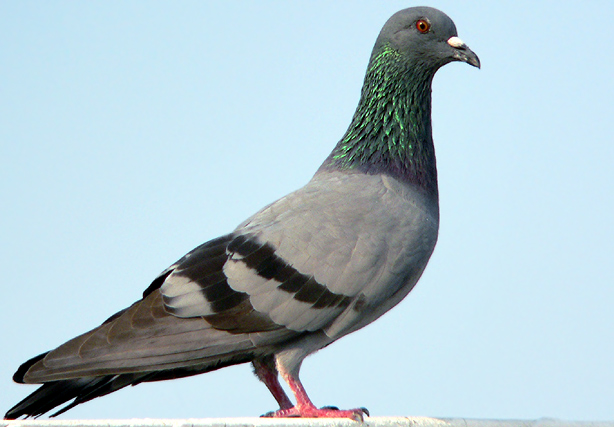 Image from: http://www.birding.in/images/Birds/rock_pigeon.jpg
Concrete jungles make for hundreds of sightings of rock-pigeons. The look in their own eyes is also pretty much stoned. Everyone who has ever lived in an apartment block has their own set of pigeon stories to tell. Anyone who has stared into the eyes of one will swear by the utter blankness that stares back at them. That is if they are in any state to talk after the staring bout. The existence of pigeons is a complete co-incidence. There is no way they could have evolved. Placed on earth by an alien race is more like it.
Neighbours of a dear friend staying at Hasmathpet road went ahead and painted their home a brilliant purple. The colour of a bright brinjal. Next thing we know, all the pigeons of the vicinity had chosen the terrace of that house to roost day in and out. E___ and the rest of us girls who had gotten together for lunch at her place, stood in the balcony and watched the birds taking off periodically, circling about like remote-controlled toy-planes and landing back softly. What gripped those insane people to do a "mera waala purple!" with a nerolac shade card, one shall never know. What attracted those pigeons in the first place to the mothership of pigeons is another question.
Pigeons do strange things to you. They startle you the most when you least expect it. They can do brilliant things really. One of the things about city pigeons is that they are forever sighted on window sills, water tanks or ventilators or sometimes squashed behind Split AC vents and no other kind of surface. A few years back, all of aged sixteen and entirely new to birdwatching, I and my Dad were standing outside the local WWF office waiting for someone to turn up. Casually I looked up a copper-pod tree and sighted two Rock Pigeons perching on the branches. And they seemed to be completely at ease while trying to be normal birds. I stood with my mouth hung in astonishment at the sight. What was obvious seemed like a revelation at that point. Pigeons. can.perch.on.tree-branches. too? Wow. It was a supreme Duh moment as well as one of amazingosity.
Then there was the time when the birders' society decided to descend at the WII in Dehra. Missing wind-vane atop building? Least concern really. As Australopithecus pointed out, "Woh dekho Kabootar!" The maniacal dear little thing was frantically rotating about where the vane should've been, hence bringing peace to the world and calming our nerves. We all knew which way the wind blew and all was right in heaven.
They have brilliant pyschic powers too. They can by dint of sheer mind-control unleash havoc upon the enemy. The other day, S___'s dad was stomping about on the kitchen floor madly and making weird noises to scare two birds that had just begun building a nest in the ventilator. Poor uncle. He slipped in the process and sprained his back and arm.
The most recent memory is that of writing our second year exams at this college. Damned pigeons set the world record for most number of successful mating rituals in the ventilators as we slogged away in the midday heat at various governmental systems. Stray down-feathers would float down occasionally and settle on our answer sheets as the pigeons cooed in delight.
And they live on. All Hail
Wednesday, May 20, 2009
Signs of the Times
I kid you not when I say that I saw the following written boldly, across the front of a parked goods truck on the Bangalore-Hyderabad highway. Strategicword-space notwithstanding:
"MAHA BOOB."
Mucho like Eats, Shoots and Leaves 'Twas.
And then today while returning home after trip, this was up on a store front:
"Flat 52% off. On Women and kids' merchandise."
(Sigh)
Sunday, May 3, 2009
Rhetoric
The thankfully brilliant idea of growing up year by year, little by little with epiphanies dawning upon one as we make mistakes and savour the beauty of life’s offerings, is one I am completely up for.:) There is a strange joy begotten from knowing you are better this year than the one before. Every shooting pain through one’s heart for a love lost makes one feel deliciously alive. Like a cold-water shower slaps the face and clears up the mind.
And though history proves a dampener with its “been there, done that” mode, one is still thankful for it. That one can seek knowledge in someone else’s experiences and words. And feel the same underneath the skin. Human.
Interning at a publishing house has its benefits. Especially when your mummy/daddy (i.e., the one you are interning under) has some cool projects under the belt. One such rendezvous was done with a text-book of speeches for an engineering institution. And several sparks went off in the head.
A radio transcript of William Lyon Phelps’ thoughts on the pleasure of books. I particularly liked the last two paragraphs.
There are of course no friends like living, breathing, corporeal men and women; my devotion to reading has never made me a recluse. How could it? Books are of the people, by the people, for the people. Literature is the immortal part of history; it is the best and most enduring part of personality. But book-friends have this advantage over living friends; you can enjoy the most truly aristocratic society in the world whenever you want it. The great dead are beyond our physical reach, and the great living are usually almost as inaccessible; as for our personal friends and acquaintances, we cannot always see them. Perchance they are asleep, or away on a journey.
But in a private library, you can at any moment converse with Socrates or Shakespeare or Carlyle or Dumas or Dickens or Shaw or Barrie or Galsworthy. And there is no doubt that in these books you see these men at their best. They wrote for you. They "laid themselves out," they did their ultimate best to entertain you, to make a favorable impression. You are necessary to them as an audience is to an actor; only instead of seeing them masked, you look into their innermost heart of heart."
I admit I don't know who Galsworthy is.:p
Jo Rowling makes you feel proud about having an imagination (an overactive one in a certain vizag junkie’s case) and on the fringe benefits of being a big-time loser. How can anyone not have an imagination? Those practical prats can take a hike through the deserts of Africa.
Jo Rowling makes you feel proud about having an imagination (an overactive one in a certain vizag junkie’s case) and on the fringe benefits of being a big-time loser. How can anyone not have an imagination? Those practical prats can take a hike through the deserts of Africa.
Though I personally will defend the value of bedtime stories to my last gasp, I have learned to value imagination in a much broader sense. Imagination is not only the uniquely human capacity to envision that which is not, and therefore the fount of all invention and innovation. In its arguably lost transformative and revelatory capacity, it is the power that enables us to empathise with humans whose experiences we have never shared.
Unlike any other creature on this planet, humans can learn and understand, without having experienced. They can think themselves into other people’s places.
Of course, this is a power, like my brand of fictional magic, that is morally neutral. One might use such an ability to manipulate, or control, just as much as to understand or sympathise. And many prefer not to exercise their imaginations at all. They choose to remain comfortably within the bounds of their own experience, never troubling to wonder how it would feel to have been born other than they are. They can refuse to hear screams or to peer inside cages; they can lose their minds and hearts to any suffering that does not touch them personally; they can refuse to know.
I might be tempted to envy people who can live that way, except that I do not think they have any fewer nightmares than I do. Choosing to live in narrow spaces leads to a form of mental agoraphobia, and that brings its own terrors. I think the wilfully unimaginative see more monsters. They are often more afraid.
Well said I believe.
Elie Wiesel’s Perils of Indifference speaks of a disconcerting but true disease we humans have dealt with over centuries. Or is it a trait? And is it only imagination that sets us free here?
In a way, to be indifferent to that suffering is what makes the human being inhuman. Indifference, after all, is more angerous than anger and hatred. Anger can at times be creative. One writes a great poem, a great symphony. One does something special for the sake of humanity because one is angry at the injustice that one witnesses. But indifference is never creative. Even hatred at times may elicit a response. You fight it. You denounce it. You disarm it.
Indifference elicits no response. Indifference is not a response. Indifference is not a beginning; it is an end. And, therefore, indifference is always the friend of the enemy, for it benefits the aggressor never his victim, whose pain is magnified when he or she feels forgotten. The political prisoner in his cell, the hungry children, the homeless refugees not to respond to their plight, not to relieve their solitude by offering them a spark of hope is to exile them from human memory. And in denying their humanity, we betray our own.
However, the speech has to be read in its entirety, as of course every other speech, to savour the entire warm feeling and retrospection that washes over you.
Thank god for the kutti-kutti joys of learning and being human.;)