Saturday, March 19, 2011

The Caravan Magazine -- an appreciation

Not having written for months, suddenly getting around to crafting a 500 word essay turned out to be major struggle. Writer's blocks, starting troubles notwithstanding, I finally got around to finishing an essay in application to an internship today. The deal with writing being, one has to just sit down and write, no matter how screwed your brain is. And eventually, the words start falling into place by themselves.

Caravan, a journal of politics and Culture: A Critical Appreciation/Review:

Fashioned after successful literary magazines abroad, The Caravan and its roster of writers boldly experiment with a form familiar to the Indian literary and journalistic community, but not the masses. Catering to a specific audience in mind, with an eclectic selection of commentaries on world politics, society, culture and photo essays, the magazine dominates an exclusive niche as the only publisher of narrative journalism in India and prides itself in the undertaking. However, widely available in bookstores, sharing shelf space with regular news magazines, and even on pavement and paper stalls, it remains accessible to everyone.

The decision to re-launch itself in 2009 comes as a risky venture in a conservative news industry where shorter forms of reporting are ascribed sharper focus and calibration and features on current affairs are the norm. Narrative journalism is the preferred form for few seasoned journalists, given its obvious risks of detracting into fiction. Also, the magazine comes especially at a dicey time when the Internet has resulted in shorter attention spans and more preference to lesser text.

The gamble is perhaps indicative of its original vision in its early days in 1940, commencing as a political magazine geared at intelligentsia and activists.  Reinventing itself as Alive in the 80s and once again returning as its original namesake, it has over time retained its editorial mission.

Though seeking to present a south Asian perspective by south Asian writers when launched in 2oo9, bulk of its writers were settled abroad, having imbibed western notions and sensibilities, thereby diluting the impact. But over the months, more writers have been drawn from the region itself, providing a platform to them and also doing justice to its original motivation.

For a literary magazine published in a complex and diverse country such as India, a journal such as Caravan has several expectations resting on its shoulders. Especially as the notion of a literary magazine is western, intelligentsia and activists in the country will look towards The Caravan developing a unique identity as time goes past, more indigenous in flavor, distinct from what it was moulded after and with a rigorous form of editing and language special to itself.

In wry humour, typical to the American publishing house McSweeney’s, the principle for the existence of its monthly literary magazine, The Believer, is furnished on its website as follows:
The Believer is a monthly magazine where length is no object.
There are book reviews that are not necessarily timely,
and that are very often very long.
There are interviews that are also very long.
We will focus on writers and books we like.
We will give people and books the benefit of the doubt.
The working title of this magazine was The Optimist.

Unintentionally, this stands true on every literary magazine’s background check. Meandering since its recent launch and assuming individuality, to keep away from this definition and launch itself into the big league will be exactly what The Caravan will need to seek. 

Thursday, February 10, 2011

Love in the time of the Digital Era

The Guardian comes up with an interesting compendium of unrequited love, on occasion of this Valentine's Day, here.

And more since we are on the topic:

Love in the time of the Digital Era

A single impression you have of mine
An impression of yours I have.
Scan them to remember the face of love
Call to remember its voice
Chat to know its tone.
Across time, distance and space.
Memories to keep us alive.

Friday, December 24, 2010

Traps and Snares: Riddled Paths for Indian Wildlife

The following report was written for the Wildlife Trust of India during my short stint there. The report is up here on their website and was also published in the July issue of Planet Earth Magazine. 

The Law is a curious, self limiting conundrum. While it attempts to delineate and sustain order, it cannot function in a foolproof manner unless everything under its ambit is spelt out well.

Consider the Ministry of Environment and Forests (MoEF) putting out the Draft Wildlife (Protection) Amendment Bill 2010 in public domain and inviting comments from experts to further strengthen it. Enacted in 1972 and amended several times thereafter, one of the proposed amendments this year is to classify leg-hold traps as weapons. Also called jaw-traps or Khadka, these simple yet deadly devices with a vice like grip are a bane to large carnivores in our sanctuaries.

The insertion of Section 9A in the principal act bans sale, manufacture and use of the article as well as regulates its possession. With a DIY style of assembly, its metal components are slipped inside the sanctuary, perhaps masked as the base of a pot and then once inside, using their impeccable knowledge of animal habits, the poachers set up the trap. The ingenuity employed here is that sans the use of guns, a poacher merely has to go back to the area later and check whether an animal has been caught instead of lying himself in wait. Large traps are powerful enough to break the animal’s leg and designed without claws to prevent perforation of the carnivore’s skin. “If found alive, brutal methods – like driving a spear through the animal’s mouth – are deployed to kill it without damaging its skin,” says Ashok Kumar, Vice-Chairman, Wildlife Trust of India (WTI) and the first director of TRAFFIC-India.

The implication of the amendment is huge. For one, the user is liable to get prosecuted for even carrying dismantled parts of the trap in and around a protected area, let alone being found with the assembled trap.  Once proven that the parts belong to a weapon when assembled, it translates to an ‘intention to hunt’ under law.  However, an appeal now stands to broaden the definition of traps under Section 2, (17 A) to include ‘leg and neck hold traps’ to avoid more legal loopholes. “While the last amendment to the act only describes snaring and trapping, this year’s addition is an attempt to define the equipment,” says Prasenjeet Navgire, Programme Officer, WTI.

The debate here is that while limiting the definition to particular limbs, court cases may not hold ground if any other part of an animal gets caught, say its tail! Sudhir KS, Karnataka based Advocate and Managing Trustee of the lawyers’ collective, Voices for Wildlife opines, “The definition of the trap should be widened to include any apparatus which may cause damage, injury or death to any animal in any manner.”

With the leg trap now undergoing redefinition, here arrives an even simpler piece of metal under the scanner – the snare.  Nothing more than a piece of wire fashioned into a smooth noose in less than three minutes, it is used to poach deer, wild pigs, boars and hares. Ironically, the very solar fences lined up on park boundaries to prevent human-wildlife conflicts are now being used to poach animals. Used primarily for bush meat, snares along with traps are our wildlife’s silent killers.

The gravity of the situation is that once a snare is set up, one can’t predict what animal gets caught. Consider the fact that in Bandipur this year, two tigers were accidentally snared and killed. The same goes for traps.  Sudhir adds, “Under the current law, leg traps exclude the fact that rodents, hefty reptiles like pythons, or any animal may get caught. As for snares, what if an elephant’s trunk gets trapped? The wire gets embedded causing septicemia or even cuts through it, rendering the animal incapable of feeding itself.”

The intensity of killing by snaring remains unknown. Areas such as BR Hills and Nagarahole have villages located within them, which makes it even more difficult to establish how many kills have taken place.  Experiments with even metal detectors for both leg traps and snares proved impractical as they are best only for restricted spaces. Even so, there have been attempts made to use them on paths frequented by animals.

“With instances such as road kills, you can give a number, 91 or 100 etc but not with snares,” says Rajkumar, a Karnataka based conservationist. With vast tracts of wilderness, Rajkumar worries that it can get extremely difficult to patrol for this piece of wire, a veritable needle in a haystack.  They are a surefire way of getting your animal. The metal wire strangles the agitating animal and death occurs by stoppage of blood flow to the brain or suffocation. “Snaring peaks around the first and second bouts of showers before the actual monsoons,” adds Rajkumar. The watering holes are replenished after a long and parched summer, and animals become easy quarry.

Tactics such as narrowing down high pressure areas around PAs based on anthropocentric disturbances and knowledge of preference for meat among certain local tribes and communities helps concentrate on a 3–5 kilometre stretch of parks like Bandipur and Nagarahole. With the support of the local RFO and some volunteers, Rajkumar conducted an anti-snare combing programme. Twenty snares were retrieved over 40 days.

Rajkumar adds that up until last year, snares were recorded mostly for hunting bush meat. But of late, they are being used for poaching large carnivores.  The problem of snares is compounded when one understands the ecological aspects. With prey animals of larger carnivores being killed, the prey base is reduced and the animals are forced to venture into human settlements and end up attacking cattle or domestic livestock. This, in turn increases human-animal conflict.


It remains to be hoped that the amendments to the WPA only further strengthen one of the world’s best conservation acts in place. India’s vast biodiversity is caught in the incredible gamut of wildlife trade. And we can only wait and watch in the thirteenth hour, however riddled the paths its animals walk may already be.

Thursday, December 2, 2010

The Lost and Found Heart


She found it lying in the most unlikely place. Such a thing, when lost, is bound to be found in unlikely places. Forlorn, cobwebbed, a thick inch of dust covering it. But the shape was unmistakable. She picked it up, blew the grey dust off it, particles of which entered her nostrils, making her sneeze. A patch of pink appeared. She rubbed it with the tips of her fingers until almost all traces of dust and the stringy cobwebs were gone. Her right hand moved to the left of her chest, and gently undid a tiny clasp on two doors on her breast. They swung open creakily. She gently lifted the pink heart up and put it in the space, shut the doors and waited. As it fluttered again, struggling to break out and fly across oceans and continents, she knew she was ready to taste life once again.

Saturday, November 13, 2010

Bubbles

A friend in Delhi is going to be operated upon today for cancer.  

In Myanmar, Aung San Suu Kyi has been under house arrest for 15 years and is expected to be released in less than 48 hours.

Light at the other end of tunnel for two people in two different lands.

Thursday, October 28, 2010

DSLRs : Democratising Photography?


At a juncture where the machine does most of the work.


While quality photography has been delivered in the hands of everyone who can afford and own a high end DSLR, as well as opening up whole new perspectives and attitudes towards capturing moments, do DSLRs really “teach” photography to us, the average?

When someone pops the question, “What camera do you use?”, a tinge of irritation grips me. Because it is no more about the hands that hold the equipment or the eyes and mind that compose the frame, but the make and features of the camera. I struggle to answer, when friends go, “Teach me how you shot that?” or “I really ought to take lessons from you!” because at some base level, i am aware that i am letting the machine work its magic. And then again, when i was first gifted my Sony Cybershot digicam, i engaged with point and shoot. And continue to do so even now, with some degree of adjustments to the ISO, White Balance etc. But never exploring technical aspects to the fullest.

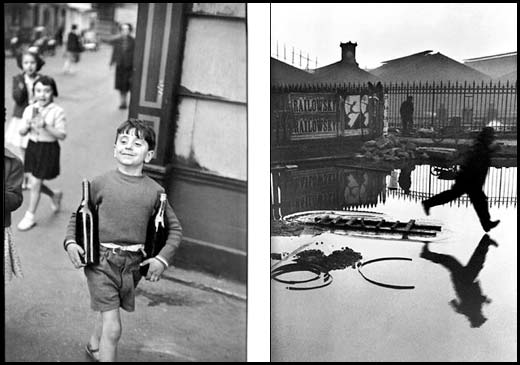
Though photo manipulation techniques have existed as long as form itself, the dark room techniques to bring out the best in a picture were based on far more complex knowledge and thinking than the simple act of tampering with contrast or colour on photo-editing softwares. Photozines too, these days, dedicate pages to explaining softwares than concentrating on the technique of understanding one’s subject, the nuances of photography etc . How long do you think Bresson spent on post processing these iconic photographs on Photoshop 8?


Or Bourke-White fiddling with the menu on her cam saying, “White Balance > Cloudy/Fluorescent/Incandescent/Night”?


Is photography today more about how pretty the picture or its subject looks than the story it tells?

Friday, August 20, 2010

Nostalgia Food

Our college visit to Madurai was under the auspices of that famous component by which the Asian College of Journalism thrives, the Covering Deprivation trip. Quite thought provoking at various levels, but also maddening because it boils down to sniffing out and snatching stories out of thin air where an unfamiliar language is spoken into. Apart from our perspective of deprivation loaded onto the villages ("oh dear lord, no mobiles! I wonder how they survive." Of course, the same village has television sets in every home along with a Sun Direct connection), there is also the matter of working on a "full stomach" while out covering stories in the hinterlands of India. 

While a certain group that went to Barmer last year, and another one that went to the Sunderbans the year before that, came back looking gaunt, dirty and hungry, the rest of us were well fed. Better, infact, than in the hostel. Now this brings us to this nightly reminscence of my first day in Madurai, and eating Idlis and vadai on a footpath in the shadow of the Meenakshi temple. With roughly half an hour to spare before being bundled into a tempo traveller for the day's schedule, two of us wandered down the alley from our hotel, very conveniently placed around the corner from one of temple's entries, in search of some little restaurant that the guys from our class had visited and declared "safe for the girls." The street was steadily growing busier, more people and more vehicles and cycle rickshaws were jostling for space.

And then in the distance, we spotted little tongues of steam issuing from a vessel slightly covered and placed on the footpath. An old lady sat next to it, frying vadai in a wok, spattering hot oil on a makeshift stove. A few patrons lined up and she served up two sticky idlis, one hot vadai on a banana leaf and then poured piping hot (it can't be anything else!) sambar genreously over the lot. I and V___ ordered for two plates and sat ourselves down on two cement bricks on the pavement next to the lady. At Rs 18/-, basking in mellow sunshine in the nippy January air, coupled with the sound of temple bells and chants ringing in the distance, it was the among the best breakfast we ever had.


Of course, now that we are on the matter of food in Madurai, one must not forget to mention, that it was here, that I tasted my first Dal Bhaati Churma in a certain Mohan's bhojanalay (i think), an authentic Rajasthani food outlet on the first floor near our hotel. Great stuff and I also learnt how to eat it the right way. "Usse poora thod kar, dal usme mila kar khaiye. Isiliye usse churma bolthe hain," aided the waiter when I tried breaking chunks of the pizza-like slice of the bread. We also had extremely awful Punjabi food in a Punjabi hotel with a Punjabi staff running it.  Lesson: North Indian food tastes good in north India. Same goes for south Indian food. 

But ah, here, the Jigarthanda must be paid an ode to. Originally from Madurai, but now popular all over Tamil Nadu and much relished by everyone, we proudly present to you:

A Tribute to Summer


As we swim our way on humid days through the yellow heat to Elliot’s Beach, all we want is a glass of Jigarthanda. As we round the corner near Murugan’s Idlis, we spot a crowd thronging a little stall outside the hotel. The men behind the counter are busy setting up cups, pouring in chilled pink liquid into them, scooping Khowa and ice-cream and handing them out to the melting customers. One large gulp and the concoction hits your stomach and a numbing feeling begins to spread through your teeth and lungs. And then, you play around with the jelly-like strands of China grass (also suspected as sea-algae or almond sap) in your mouth and gobble it down. And then the sweet after-taste of nannari, khowa and basundhi lingers. All charged up, you bound your way through the heat beating down your neck. Priced at Rs 15/- and Rs 20/- for the medium and large cups respectively, the Jigarthanda is originally from Madurai and every outlet you try the drink from has its own signature style of making it. Hence the flavour differs marginally from place to place. The recipe is difficult to get hold of, but Wikipedia has a version here. Some citizen reporter soul has even put up a video on YouTube. Please don’t let the sweaty hands of jigarthanda seller put you off from trying Summer’s flavour.